
How to Look Up Jefferson County Jail Population Data
No single Jefferson County dashboard publishes the kind of full population profile a researcher or budget analyst expects. A clean answer comes from three sources used together: Sheriff publications (annual report, budget, presentations), the county's adopted budget book, and outside data sources such as the Bureau of Justice Statistics, the Vera Institute Incarceration Trends tool, and the Prison Policy Initiative. Each one has a different unit of analysis. The Sheriff knows current operations. The county budget knows funding levels and staffing. BJS knows nationwide jail counts. Vera knows long-run county-level trend estimates.
The Sheriff's live inmate lookup updates every 15 minutes. It is operational. It is not a population dataset. A point-in-time roster may exclude juveniles, people in transit, sealed cases, or records still being verified. Always label a one-day roster count as "current lookup count on [date/time]," not as average daily population. For individual-inmate name lookups, the right page is inmate records.
Jefferson County Jail Capacity Overview
The Jefferson County Detention Facility has stated capacity of approximately 1,300 inmates. It is 388,000 square feet, opened in 1986, expanded in 1999, and accredited by the American Correctional Association (ACA) and the National Commission on Correctional Health Care (NCCHC). The facility includes housing units for varying security classifications, medical and mental health units, intake and release areas, and courtrooms.
| Facility | Address | Capacity |
|---|---|---|
| Jefferson County Detention Facility | 200 Jefferson County Parkway, Golden, CO 80401 | ~1,300 inmates |
Jefferson County operates only one detention facility. There is no satellite jail or work release facility published as a separate site. All adult custody for the Sheriff's Office runs out of this one campus.
Average Daily Population
Average daily population (ADP) is a routine measure used in jail-budget and policy analysis. It is the average number of inmates in custody on a typical day across a defined period. Jefferson County's official pages do not publish a current ADP on the Sheriff site. ADP figures show up in budget books, jail standards reports, and annual reports.
If a published ADP says 1,040, that is 80 percent of the 1,300 stated capacity. If ADP runs above 1,300, that is over-capacity territory and usually surfaces in budget discussions and policy debates. Treat any ADP claim with care. Confirm the source, the period covered, and the agency that produced the number. Do not infer overcrowding from a single high-roster day.
Demographic Breakdown
U.S. Census QuickFacts provides population baselines that help contextualize a county jail's footprint. Jefferson County's population is in the hundreds of thousands. The Sheriff page describes the county as Colorado's fourth most populous per the Judicial Branch.
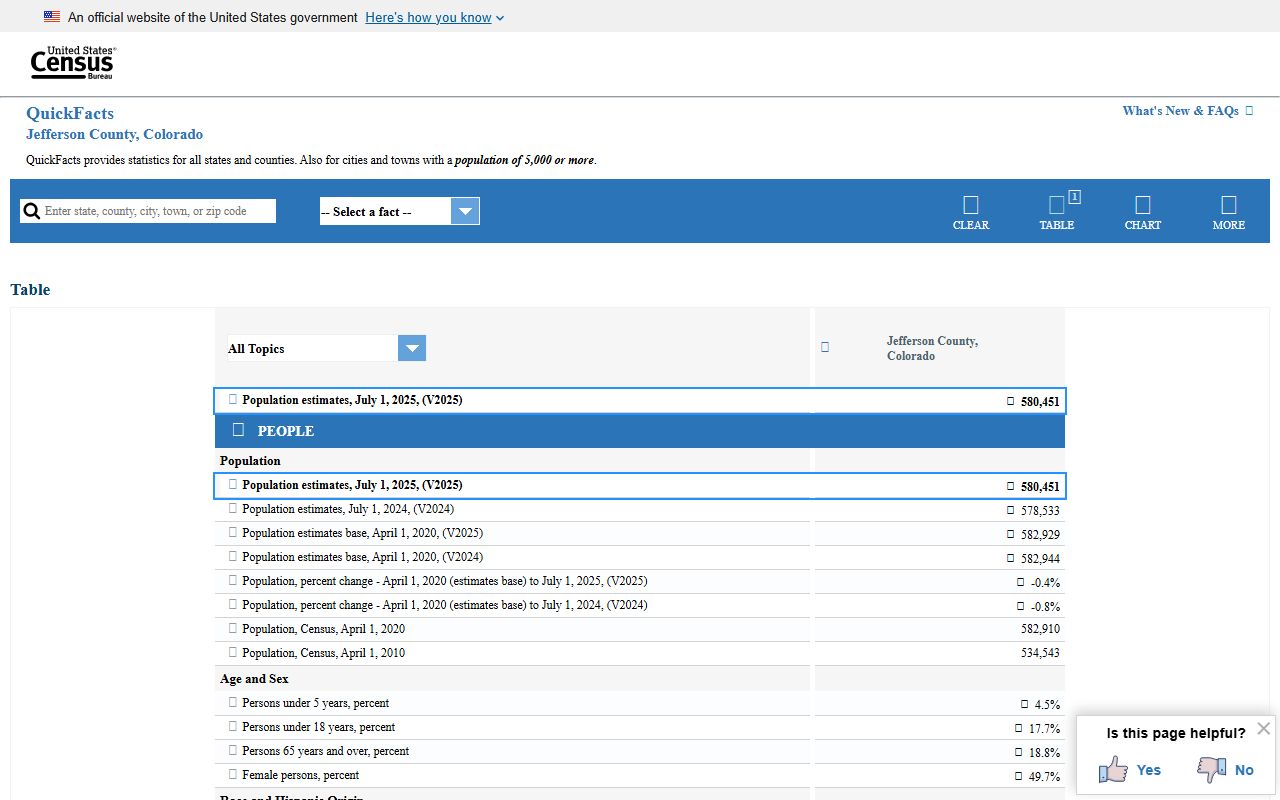
The Census QuickFacts for Jefferson County page gives population, age, race, housing, and income baselines. The Census data is not a jail count. It is the denominator for "per 100,000 residents" comparisons used in jail policy work.
Pretrial vs Sentenced Population
Most county jail populations split into pretrial holds and sentenced custody. Pretrial holds are people awaiting court action who have not been convicted. Sentenced custody is people serving a misdemeanor sentence at the county level or waiting transfer to state prison after a felony sentence. The split matters because pretrial holds reflect bond policy, charging decisions, and court speed - not the underlying crime rate.
Official Jefferson County pretrial vs sentenced ratios are not published on the Sheriff site in the materials inspected. A reliable answer comes from the Sheriff's annual report or the county budget book. Outside hubs sometimes estimate the ratio from BJS Annual Jail Survey returns. Use those carefully and credit the original survey.
Misdemeanor vs Felony Population
The Jefferson County Detention Facility holds both. Felony custody includes pretrial felony holds and short-stay felony custody before transfer to Colorado DOC. Misdemeanor custody includes misdemeanor holds and sentenced misdemeanor inmates. Class severity affects average length of stay. Felony cases run longer than misdemeanor cases on average.
A useful proxy for the felony/misdemeanor mix is the docket-class distribution at Jefferson Combined Court. CR class cases are felony. M class cases are misdemeanor. Pulling docket counts by class over a defined window gives an indirect read on what flows into the jail. The result is not the same as actual jail counts, but it tracks them over time. Probation revocation hearings on the docket can also signal an inflow surge that a roster scrape will not catch.
Mental Health and Medical Population
The jail page states the facility includes medical and mental health units. Jail Based Behavioral Health Services (JBBS) is a state-funded program that delivers substance abuse and mental health treatment through community partners. Participation is voluntary. JBBS is also part of the Sheriff's recidivism reduction priority.
Specific behavioral health population counts are not published on the inspected pages. The facility includes a medical unit, a mental health unit, and on-site programming, but the breakdown of housed inmates by treatment category is not part of the public Sheriff site. The jail's intake and release areas also affect daily counts. People may book in, see a judge at the in-house courtrooms, post bond, and release without ever appearing in a long-term housing count.
What Drives Jefferson County Jail Population
Most jail populations are shaped by a small set of inflows and outflows. On the inflow side: pretrial felony holds, misdemeanor arrests, probation revocations, warrants and failure to appear, domestic violence holds, DUI and traffic matters, drug and property cases, mental health holds, and state or federal holds. On the outflow side: bond posting, court orders, sentence completion, transfer to Colorado DOC, and transfer to federal custody.
None of these inflow categories is quantified on the Sheriff site at the level a budget analyst would want. Confirm with the county budget book, the Sheriff annual report (if published), or a public records request through NextRequest. The Sheriff's Records Unit can route aggregate operational data requests for booking and release counts where the underlying records are public.
National and State Context
The Bureau of Justice Statistics tracks jail and prison data nationally and at the state level. The Vera Institute Incarceration Trends tool publishes county-level historical estimates derived from federal data sources. Prison Policy Initiative publishes state-level overviews.
The Bureau of Justice Statistics is the federal data hub for jail and prison statistics. The agency publishes the Annual Survey of Jails, the Census of Jails, and the Jail Inmates report series. Each one has a different scope and release schedule, but together they give a national baseline for any county-level comparison.
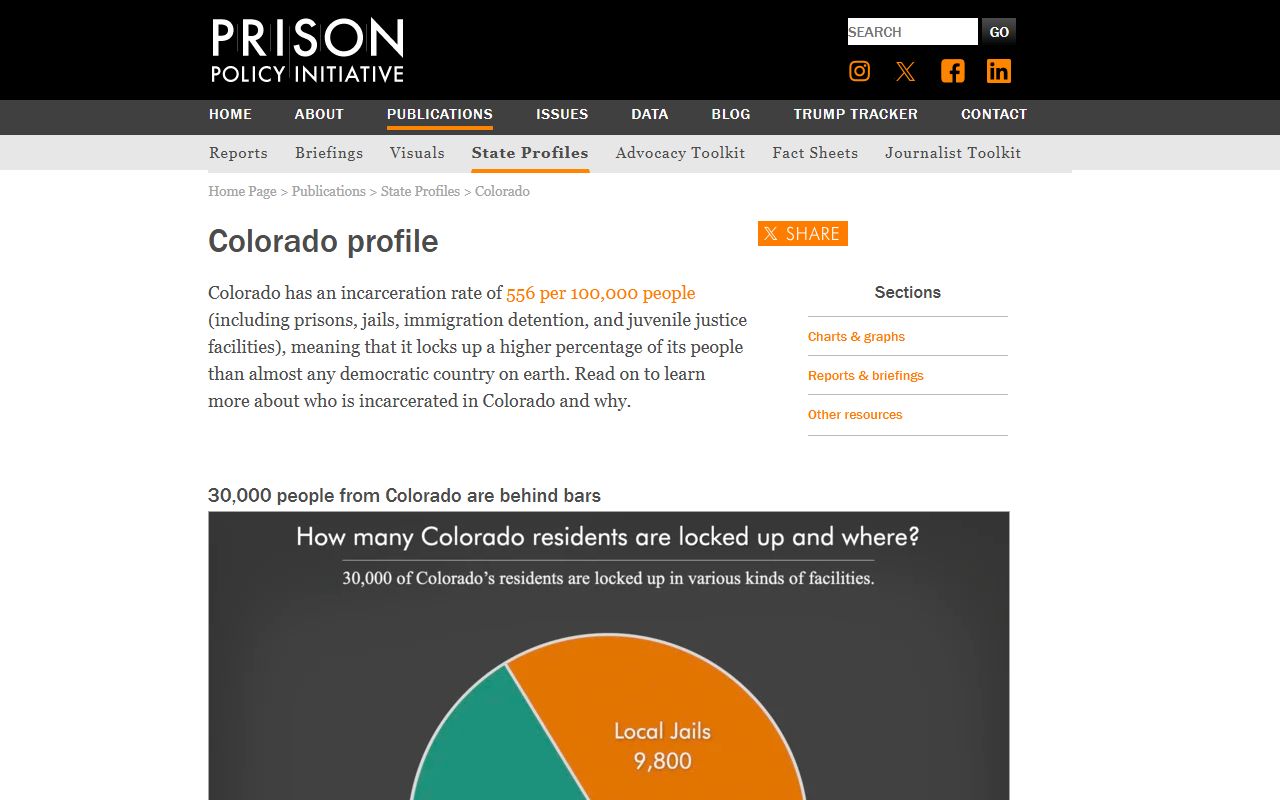
The Prison Policy Initiative Colorado profile covers state incarceration rates, jail and prison populations, and policy notes. State-level numbers are not Jefferson County numbers. Use them as context only.
| Rate Measure | What It Tracks |
|---|---|
| County rate per 100,000 | Jefferson County jail population divided by Census population, scaled to 100,000. |
| State rate per 100,000 | Colorado jail and prison population scaled to 100,000 - used for state-level comparisons. |
| National rate per 100,000 | U.S. jail and prison population scaled to 100,000 - published by BJS. |
Compare a Jefferson County rate against the Colorado rate, then against the national rate. The three together explain whether the county runs hotter, cooler, or on par with state and national trends.
Population Trends Over Time
Long-run jail population trends in Colorado have moved with charging policy, bond reform, treatment-court expansion, and statewide population growth. The Jefferson County facility's expansion in 1999 from a 1986 build reflects the late-20th-century growth in the Front Range. The Sheriff's recidivism reduction priority and JBBS treatment programming are post-2000 responses aimed at the back end of the population pipeline.
For a specific Jefferson County trend chart, the right starting point is the county adopted budget book, the Sheriff's annual report (if published), and Vera Incarceration Trends. Always note the data vintage. A 2024 dataset is not a current operational snapshot. A 2026 budget projection is not a measurement.
Searching for Individual Inmates by Name
Population data is aggregate. For one person, use the Sheriff's inmate lookup. The page at jeffcosheriffco.gov/jail/inmate-lookup handles current-custody searches by name or booking date. The lookup is operational, not historical. For full instructions on name lookup, see the inmate records page.
This page focuses on aggregate jail population data and capacity. Individual-inmate name lookups belong on the inmate records page, not here. Mixing the two confuses readers and produces wrong conclusions. The line between data and operations matters, especially when bond and release timing are in play.
Where the Data Comes From
Trustworthy Jefferson County jail population data has a small set of sources. Pull from the Sheriff's annual report or operations dashboard if and when published. Pull from the Jefferson County adopted budget for staffing, capital, and program costs. Pull from the Bureau of Justice Statistics for national baselines and from Vera and Prison Policy Initiative for state and county trend context.
Do not pull from a single-day roster scrape and call it a population number. Do not use Vera's national estimates as if they were Jefferson County operations data. Do not mix state-level Prison Policy figures with Sheriff custody data. Each source has a place in the picture, but each one only fits one role at a time.
Note: The facility's ACA and NCCHC accreditation are quality and standards facts, not proof that population levels are low or conditions are compliant at all times.